Can we please stop calling them horror films?
We’re All Going to the World’s Fair was Schoenbrun’s debut effort and it is a great film. The digital film fest I saw it at—Nightstream, maybe?—touted it as a visceral and raw horror film unlike anything, blah, blah, blah…and when I watched it I was severely disappointed it was not as advertised. My disappointment was short lived as I was however completely enthralled with what I did see.
I Saw the TV Glow was also touted as “the best horror film this year” and “shocking” and ” twisted” and it was none of those things. Despite what everyone I spoke to about the film, I could not fit my mind around what I saw and what people were telling me it was. It was, again, not a horror film. (It was however a very moving indie drama dripping with magical realism. I dig it through that lens.)
Teenage Sex and Death at Camp Miasma is the newest film by Schoenbrun and it too is not a horror film, though it does stray close at times. It is however being touted and marketed as the “best” “strongest” and “intense” horror movie of the year and I do not know what the f*ck people are on about.
Obsession is a horror film, The Backrooms is a horror film, Hokum (which is my favorite film of the year so far) is both a fantastic meta commentary on writing, ghosts, and a horror film. So what is Camp Miasma?
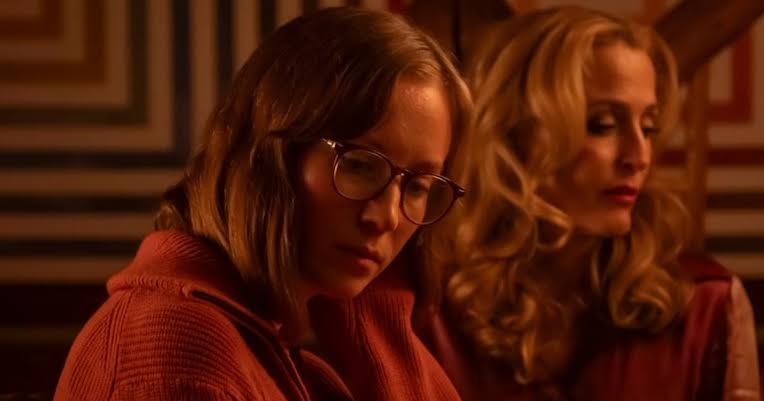
Starring Hannah Einbinder as a Sundance Wunderkind named Kris and Gillian Anderson as the Norma Desmond of a failed slasher franchise, a one time scream queen named Billy, it is a brilliant, beautiful, and rather stunning indie art film that plays in a multitude of genres without ever committing to one and remaining true to its metacommentary of horror genre tropes, film analysis, and sexuality. It has horror elements sure, but to call it a horror film feels restrictive. Going in to the film thinking it is a horror film will lead to disappointment, going in knowing it is a hodgepodge film will lead to a much better experience.
I had that experience with I Saw the TV Glow. I went to see it with my girlfriend at the time and we had both seen the marketing calling IStTG a horror classic and such. When we left the film we were bitterly disappointed. Almost nothing happened until the unzippering scene at the end that could be considered “horror.” I was pissed at the bait and switch. In preparation for Camp Miasma I rewatched IStTG again and this time I did so with the expectation that I was watching a coming-of-age indie drama and you know what? With that set of expectations, the film is brilliant. It speaks to Schoenburn’s struggles as a person and is relatable to most viewers. The uncertainty of your place in life, finding that thing that connects you to another person, fandom as lifeline, etc. It is all there, and it’s done with style. I loved it as the film it is and not the film that critics and folks tried to sell me on. That film does not exist.
The same holds true for World’s Fair. It is also very much not a horror film, but it is a fascinating and powerful piece of drama.
Knowing that, I went into Camp Miasma with the same attitude. I was expecting a film that was ABOUT horror and the fans and everything in between, but I was not hopeful that the narrative messages would be delivered in a meta-horror film ala Scream. I was hopeful, instead, that Schoenburn would do exactly as they did. Now there is a horror movie here, but it is a film within the film and it mostly serves to highlight the main narrative, which is a fun way to approach the way the horror genre is treated by studios and executives and fans while we watch the relationship between our leads grow.
What I found particularly interesting was the cuts from the meta-film-within-a-film. At one point Einbinder interjects that a scene is now considered transphobic and problematic. I think that the response that Schoenburn wrote for Anderson to reply with is especially telling. Anderson’s response is simply, “Shhhh.” It feels like Schoenburn is telling fans and folks to let old media be old media—warts and all. They are using the film medium to explore their own journey, every one of Schoenburn’s films has a character that has direct parallel to their own journey. In this case both Anderson and Einbinder are a split version of Schoenburn’s psyche. One part is very, very online and analyzing and trying to find ways to be outraged and to subvert the society around them and the other part is the Anderson part, the part that recognizes that sometimes things are as they are and should be appreciated as such. She is the Danny Butterman to Einbinder’s Nicolas Angel and is encouraging the hyper critical part of the brain to simply allow these things to happen without over analyzing, to actually live. This plays out in the romance that stylishly blossoms between the two leads as the film advances. Culminating in a scene that depicts sex as something messy and confusing and mentally confounding and…totally relatable, not matter your orientation. Dipping sauces indeed. That the romance and seduction plays out like a horror movie meet cute only made the film better to me.
Now earlier I said the film is a film about a horror movie and not a horror movie itself, but there IS a horror movie (albeit a short one) and it is a fun slasher concept with a variety of fun kills presented in a madcap, almost music video montage. If you heard the title of the film and showed for a summer camp slasher, then here it is. And if Schoenburn decided to release a series of films that match the Miasma history presented in the film, I think we’d have a truly fun series on our hands. The energy and camp that they brought to the screen in the short film we get would be fantastic as a series.
The end of the film could have gone full horror film, but it would have felt disingenuous. Instead, Schoenburn chooses magical realism as their characters fall more deeply in love—feeling something approaching “real” and “connected” for maybe the first time ever—as the film slips into full magical realism. From here the slasher trope becomes a metaphor for connection, sex, kink and —finally—orgasmic release as our two star crossed lovers embrace their shared desire-fueled madness and Einbinder’s Kris cuts loose from the (dead) weights holding her back as she embraces her new life with Anderson’s Billy. It is a wonderful and earned ending to a film that is less slasher than psycho-sexual magical surrealism with the beating heart of a cult classic.


Leave a Reply